Archive for ‘Man vs Land Rover’

One man’s struggle against the pinnacle of British engineering – tools, blood, swearing – what’s not to like?

Bush Mechanics in Lesotho and Namibia

Whilst being laid up here in Walvis Bay I have time to catch up on Man vs Land Rover.  We have had a few issues of late, requiring professional intervention (shiny new head) as well as some of my traditional “just get it working again” medicine.
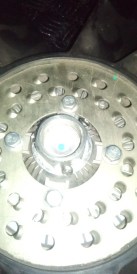
fanViscous fan – in a nutshell, this stopped working efficiently, causing overheating on the mountain passes in Lesotho.  I hadn’t considered this as a cause (the fan had only about 30k on it), so thanks to Paul at The Centre in Durban for the idea. Chatting/swearing about how to lock the fan mechanism in the campground (sorry mate, I didn’t get your name!) let to the revelation that people in a Jeep had tried to use epoxy, but the heat killed it pretty quickly.  “Aha!” thought I, i’ll drill some channels and slap in a few self tappers.  It worked flawlessly, problem solved until he fan was replaced back in Durban with a shiny new one.


Roofrack leg – back in Europe, the captive nut in one roofrack leg failed, necessitating a quick bodge with a nut and bolt.  Not ideal, so I bought a new leg in Joburg and fitted it.  Naturally I didn’t torque it correctly, so it vibrated loose here in Namibia (new rattle detected and identified, problem sorted in Solitaire whilst hopping around on one leg waiting for my knee to start working again (see previous post).
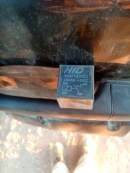
relayLight relay – whilst driving back in the dark from Dune 45 to the campground, we lost our high beam headlights.  Inconvenient (as there was game around) but not the end of the world as we have VisionX lamps on the bumper (with fog covers, but better than nothing).  I have identified the fault as a failed relay in our Boomslang light harness, an easy fix once I can get on the roof to my spares box (or talk Margaret into fossicking around).

busted shockLost suspension bolt – this one was a bit more serious.  Whilst juddering along the most corrugated road on earth, one of the rear shock absorber mounting bolts vibrated out, and we didn’t immediately notice (the juddering was that bad).  A few km later we stopped for a breather, and something made me check the shocks… the shock mount on the chassis had been bent off at nearly a right angle to where it should be, the shock was dented and its dust cover ripped off, and there is a gig shiny dent in the floor where the shock had been hammering it.  In true bush mechanic fashion much swearing was deployed, buying time for a solution to be dreamed up before family meltdown occurred.

Margaret was sent down the road with a walkie talkie to search for the bolt (handy having a runner available) while I attacked the chassis mount with my trusty landy-hammer (copper mallet, good for hitting sensitive things really hard and not worrying too much about denting them).  With the bracket now roughly back in shape I dug into the roof boxes and found a bolt of the right length, diameter and thread – albeit not high tensile – called Margaret back and remounted the shock.  A few bits of Gorilla Tape and the dust shield was also back in place…  rolling again!  A new shock is arriving on Monday, and we will also source a proper suspension bolt to replace my #8 wire solution.


The Taniwha is on strike!

flatbed

So… I write this sitting on the patio of the (very long-suffering) Leanne and Trevor in Durban, South Africa. Yes, the Taniwha is on strike and requiring shiny gifts. It’s a bit of a saga, but the condensed version is as follows:

In Morocco we developed a leak in one of the seams in the radiator – inconvenient, but not a show stopper. We sourced a bottle of stop leak in Zagora, topped up the coolant and the problem went away for a while (in hindsight, I suspect this leak was caused by the beginnings of pressure buildup in the system, but I wrote it off as a casualty of the serious jarring the vehicle was being subjected to in the desert). We returned to the UK, and all was well.

During my pre-shipping checks in Britain I discovered the coolant was getting low again – maybe 750ml down – and with pressure (gas) in the reservoir. At this stage I added “head gasket” to the list of jobs to attend to in Durban, before heading out into the continent.

On arrival in Durban, I booked the Taniwha into a local specialist to work through the list of jobs (quite a few actually). They identified the radiator leak and had it properly repaired, test drove the truck and all appeared well – the diagnosis being air entering the system through the radiator leak, and not actually a head gasket issue after all. We loaded the truck up and headed out into Africa… making it roughly 30km before we properly overheated. After a sufficient cooling off period, I refilled the coolant from our water tank and limped back to Durban at tickover (stopping three times to cool off, and adding over 16 litres of water all up).

Given that the head has been properly cooked, and the amount of remote travel we will be doing, I have made the call to replace the head with a new one (AMC, from Spain – improved design, thicker injector pockets etc) – this was being shipped overnight from Johannesburg and “should” be arriving today… fingers crossed the Taniwha accepts this truly magnificent gift and resumes normal duties! We are now both several weeks behind schedule and seriously imposing on friends, not a happy combination at all.  A truly appalling run of luck, we are avoiding casinos for the foreseeable future.

solarThe unscheduled layover in Durban has given me some time to investigate a charging issue detected in Morocco with our Solar solution – we noticed a sharp decrease in capabilities and had to plug into mains far more often than anticipated in a desert country. Afer opening up the back of the panels and testing with a multimeter, it appears that three out of four panels were completely dead, with the final panel providing around 0.4 amps (out of a “normal” 4.0). All is explained… Unfortunately the manufacturer of the panels has no African presence, and sending the panels back to Oz for analysis and replacement back to us here is simply out of the question, so we have resorted to replacing the system with a local South African brand. We have also bonded a 110w rigid panel to a sheet of marine ply, which we will lash on top of our roof load to provide a trickle charge when we are parked up but unable to lay out our ground panels. This panel can also be plugged in alongside the ground panels when camped. Total capacity, 320 watts. Testing here in the garden in full sun gives us around 14 amps/hr back to the batteries, a good result. After running both fridges and the freezer overnight, we were back to 100% by lunchtime on solar alone, so problem solved…
Cyclone Idai has scuppered our plans of doing Africa in a loop – we had intended on heading up through Mozambique and Tanzania, keeping as close to the coast as possible before heading inland at Kenya and up into Ethiopia and Sudan. We then intended to turn around at Khartoum and head back down the center of the continent, through Uganda/Rwanda etc before looping through Namibia and Botswana and back into South Africa at the end of the year. Obviously this is no longer a viable approach… and given the timings of wet seasons simply reversing the loop doesn’t work either.  Plan B is to head to Namibia, visit around half of it, then cross into Zambia then Tanzania, and work north from there, returning again via Namibia in October (will visit Botswana after this – a rough figure of 8 route). Clearly this plan will fall apart and be reworked as we go along…

Mechanical thoughts 5 weeks in…

tire

Venice, Italy.

It has been a VERY busy 5 weeks.  We have covered 10,773km, and driven through England, France, Belgium, The Netherlands, Germany, Denmark, Sweden, Norway, Finland, (boat trip to Russia), Estonia, Latvia, Lithuania, Poland, Slovakia, Hungary, Croatia, Slovenia and are now in Italy. Home in around 10 days time.

Given how heavy the Taniwha is (it is REALLY heavy, especially with full water and longrange fuel tanks) I have been pretty happy really with how things have gone mechanically, all things considered.  When the extreme distances we have covered are added to the compressed timescale (and with some pretty wild weather thrown in) the old fella has done well.

However..  things are not perfect.  I have come to the conclusion that the aftermarket hubs that are fitted aren’t going to work out for us – I am sure that on a “normal” Land Rover (if such a thing exists?) they would perform flawlessly, but given the weight and constant stresses ours are under they are showing the strain.  We have a bit of bearing grumble front and rear, and none of the hubs are more than 12 months old.  So..  something to sort out back in the UK before we hit Morroco and more serious terrain.

We have a slight oil leak from the turbo drain pipe (I think I may have cracked a weld when I was wrestling with the manifold pre-trip), so I will need to replace this – not a biggie at all and the leak is very minor by Land Rover standards.

Storagewise, still some changes needed in the rear.  Too much stuff loosely packed.

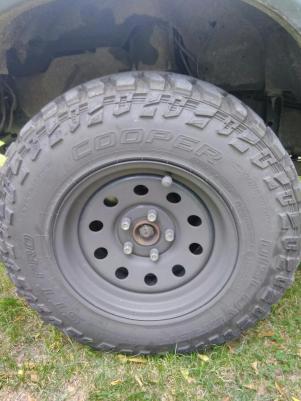
Tires – I have been really impressed with the Cooper Discoverer STT Pro tires we fitted before this trip.  Roadhandling is exceptional, snow/ice they stick like glue (Thanks, North Cape..).  Ride quality is superb.  Given these are proper mud terrain tires, this is a huge surprise.  Yes, they are pretty noisy – but it’s a Land Rover so is very noisy anyway. Orchestras need many instruments.

Water tank/Pump/Filters – working very well indeed.

Bonnet chequerplate – a really good investment.  Margaret climbs up the bonnet to get to the roof boxes, no hint of buckling yet.  I will be adding some grab handles in the UK to assist in the wet.

External mains power hookup, USB and 12v sockets – superb.  I am using all three right now.

Fridges and Freezer – we have a perfect setup for us now. I need to run heavier wire from the distribution board in the boot to the middle seats, as we are getting an unacceptable voltage drop.  But it’s all working nicely.

Navigation Systems – Garmin, sort your $h1t out!!! I foolishly updated the software, maps and camera database before we left.  Naturally, the build is as buggy as hell, and is happily screwing up routing and mis-reporting speed limits (90 in 50 zones, etc…).  I sense some fines coming in the post. There has been much swearing directed at it, and not the usual good-natured Antipodean sort.

Remapped ECU – MUCH more power.  Possibly too much in built up areas.  I think I will use the factory ECU for on-road, and the remapped one for when we need the power… it simply doesn’t like rolling along at the speed limit.  And it is thirstier, despite the engine running a few hundred RPM lower than the factory ECU… not sure how this works – maybe it is injecting more fuel?

Anyway, more musings as and when I have them.

Final pre-Europe spannering…

*Written from the legoland campsite in Denmark* So we had a few issues to resolve in the last days before leaving the UK for the continent.  To cut a long story short, the viscous fan bearing went in quite spectacular fashion (close to home, and fortunately didn’t send the fan through the radiator).  The exhaust also decided to start making contact with the gearbox crossmember (sorted out by Nick Kerner 4WD near Windsor, thanks guys).  And… I somehow managed to warp the exhaust manifold (probably related to the tasteful level of tune applied to the engine, combined with a heavy foot on the way back from Wales).  This was not much fun at all to fix – in the end I sourced a replacement manifold, as we had no time to get the original skimmed flat again.  More than 1000km in (and driven hard) there is no sign of a repeat issue, so hopefully there is a line drawn under this now!  It was a bugger of a job, especially as we were due to drive to Dover the following day to catch the ferry.  As the image with the spirit level shows, there was a significant warp (around 2.5mm).  Amazing how much noise this can generate, once the gasket begins singing…

On a more positive note, I am pleased to recommend the Canvas and Nylon Company to anyone needing rooftent repairs, sails, whatever… (https://www.canvasandnylon.co.uk/) – sorted out our rooftent cover within a few hours (this is the appalling stitching quality from factory that I was complaining about a few months back – Nakatanenga of Germany, hang your heads in shame…) – top service from Nick, cheers mate!  It is now reinforced as it should have been from day one…

Heavy breathing…

The TD5 engine is a famously heavy breather – and not in a good way unfortunately.  Given we now have a shiny clean intercooler, it makes sense to try and keep it that way going forwards, rather than let the well intentioned (if a little half-arsed) attempt by Land Rover to “Greenwash” their engineering solutions by diverting the oil vapour (that would otherwise waft free) from the crankcase back to the combustion chamber (via the turbo, associated pipework, and intercooler).  The intercooler fills up with oil and crap, and efficiency goes downhill thereby negating any “Greenness”.  It’s a rubbish solution, especially when combined with the (obviously removed already) EGR system.

Provent4

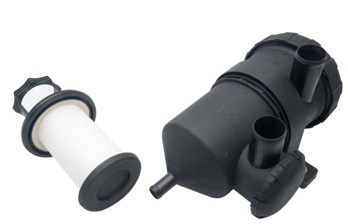
A far more sensible solution is to install a proper oil separator such as those used on trucks (not a catch-can, they are rubbish).  Mann and Hummel make a particularly good one (Provent 200) that can be muscled into the TD5 Disco2 enginebay in a few places.  By far the easiest option (and the one everyone else seems to have chosen) is to mount it on the firewall, behind the ABS valve block.  Unfortunately this is also the only place that you can shoehorn a second battery, which I have done already — so it’s a non-starter.

Provent 2

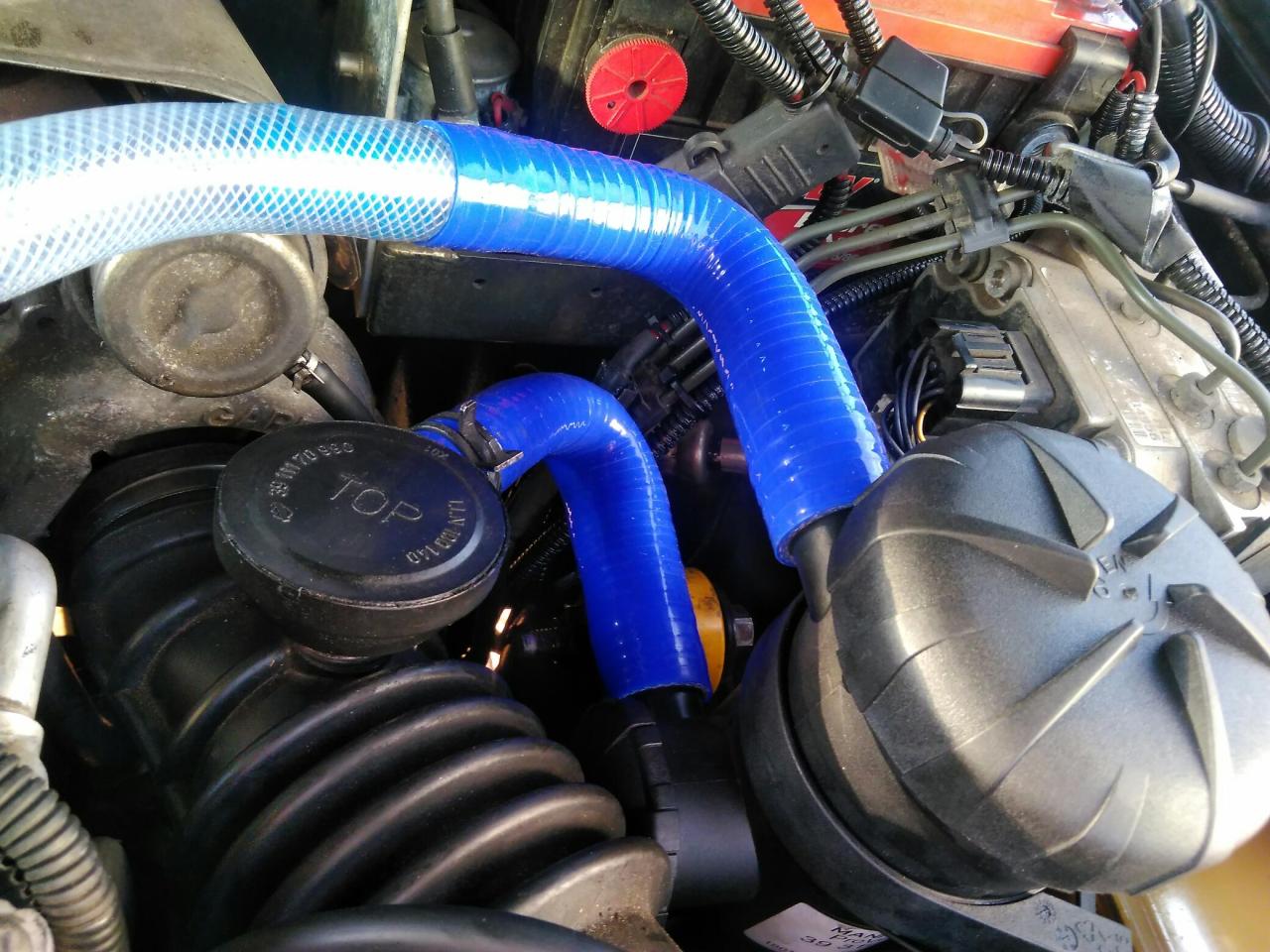
My solution to the tetris challenge is to mount the Provent to the ACE/PAS reservoir (it’s very light – only a few grams) with a few chunky zipties.  Rotating it so it’s on a nice jaunty angle means that using a silicone reducing elbow I  can connect the outlet directly to the factory turbo intake pipe… nice and simple.  The inlet is connected (again via a reducer) to an insulated braided hose run from the outlet on the rocker cover (the top of the engine).

Provent 1

The nasty oily vapour exits the rocker cover and flows down the braided hose to the inlet on the Provent.  It enters the inlet chamber, where it condenses on a filter element, allowing nice clean air to exit the bottom hose and make its way to the engine air intake to burn up in the fiery hell of Solihull 5 cylinder combustion.  The condensed oil flows down to the base of the Provent, and then out down a collector tube (a foot of clear silicone hose – clear, so I can see if there is oil collected) and remains there until I get around to crawling under the car, opening the tap, draining it into a cup, and putting it back into the engine…  Now why didn’t they design it this way at the factory…?  Could it be that cleaning out an intercooler is a nice profitable dealership service item?  Surely not…

provent3