Archive for ‘Roaming’

Posts about our travels…

Sehlabathebe National Park

We did a lot of bumpy roads to get to Sehlabathebe National Park. We camped next to an old lodge. The next day we did a really long walk. Daddy said it was the same as a half marathon! (21km)

We were trying to find Tsoelikanyane waterfall, but we got a bit lost. The path wasn’t very clear and there were no signs. Finally we found it! Daddy threw a rock and we counted to 4 before we saw it splash.

IMG_8095

On the way back to the car Daddy nearly stood on a snake. It hissed at him. When we checked in our animal book, it looked like a Mozambique Spitting Cobra!! It was a bit scary.  We also found a porcupine spike. We were looking for a bearded vulture but the birds in the sky were up too high to see properly.

In the afternoon we looked around some of the rocks. They were very cool.  Some were like caves and had stone walls underneath. Some of the walls were for a house and others were a corral for animals. On the top of the rock you could see where the water had worn through. There was an arch, and one really big rock that looked like a table!

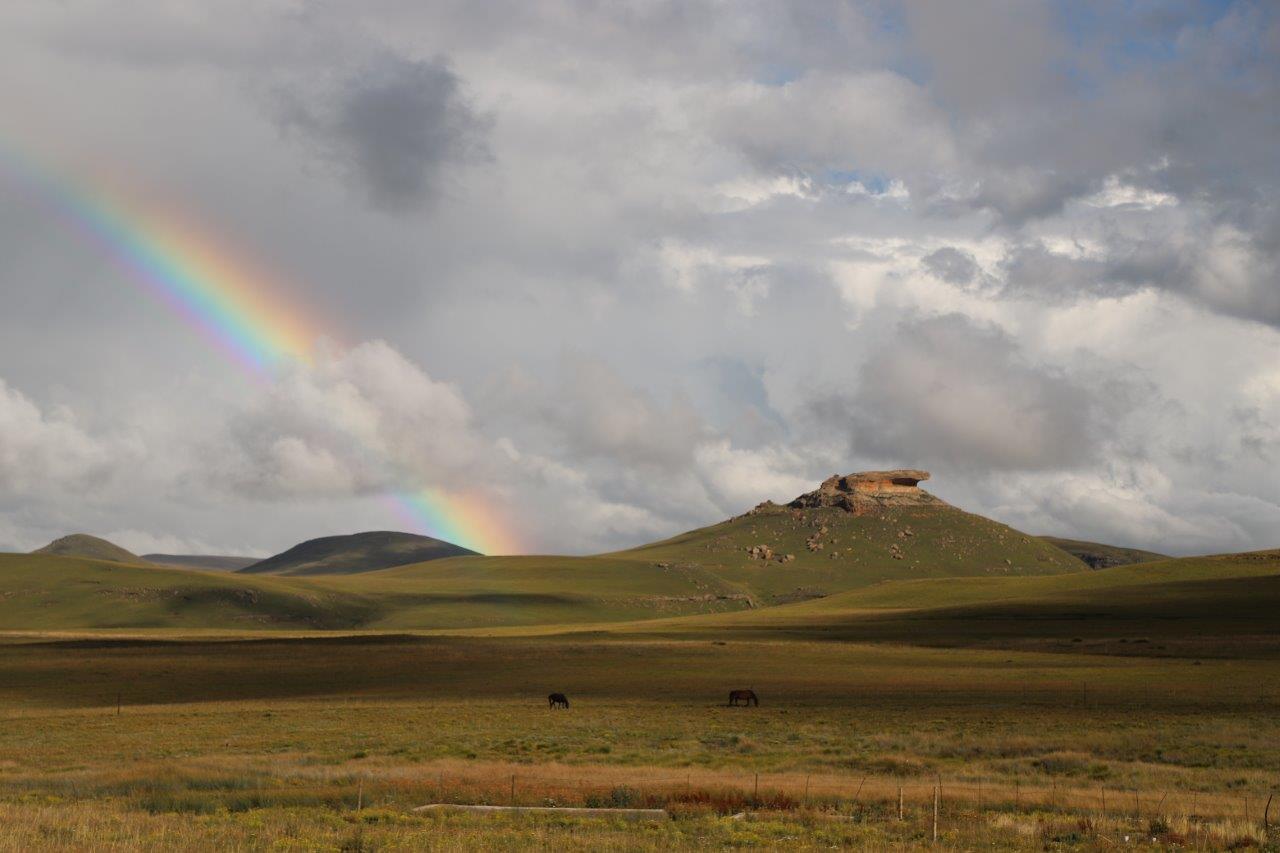
I saw a rainbow, it was beautiful. Then we headed back to Durban.
IMG_8151

Thaba Bosiu & Kome Caves

Today we had a very busy day. We first went to Thaba Bosiu, the mountain where King Moshoeshoe I started Lesotho. He joined together 16 clans. Each clan was represented by a different thing.  Like elephant; crocodile; hare; spider; wild cat; pet cat; pumpkin; cloud. There was a tradional village there and the guide showed us the differences between the clan houses.  The stone wall rondavels came from the Irish.

Traditional bushmen rondavels were made all of stone and had a low entrance. The were so low that I couldn’t get in unless I slid on my tummy in the mud. The entrance is low to make it easy to defend. Any animal or bad guy coming in has to duck its head and the bushmen can hit it with a club.

We also learnt how to play the shepherds game. It is a bit like the noughts and crosses and connect 4 games.  You have 12 pieces and you try and get 3 in a row. If you do, you can take off one of the other players pieces.

King Moshoeshoe I:

IMG_7914

After that we did a dirt track to the Kome Caves. The caves were another overhang but in the 1800’s the people had made some walls out of mud/clay. There are three grandmothers that still live there! One is 89, one is 84 and one is 64. We were allowed to go into their houses. The biggest house had a real bed, a shelf of food and a gas cooker. But in the other houses the grandmothers slept on mats on the floor. There were some bushmen paintings on the ceiling, but because of all the smoke from the fires, they have disappeared. There were lots of children there, from Maseru, who were learning how to cook over fire. I tried to use the grinding stone, but it was hard. We also learnt that there were some cannibals that lived near by. Cannibals are people who eat other people!

On the way back to Maseru, we stopped at a weaving place. There were lots of wall hangings and we saw a guy making a floor mat. He said it would take 3 weeks to finish.

Leribe Craft Centre and Katse Dam

We went to the Leribe Craft Centre and a lady gave us a tour. They sell blankets, wall hangings, scarves and things made from mohair wool.  The lady showed us where they comb the raw mohair and spin it in to wool.  The spinning wheels were all made from bicycle wheels! We also saw lots of looms where they make the blankets and scarves.  It is all done by hand. We also saw where they wash and dye the wool.

Then we drove to the Katse village. We went over the Mafika Lisiu Pass. But the taniwha got too hot, so we had to stop and let it cool down. There were lots of people walking on the road. Some had sheep/goats/cows or donkeys.  Some women carried big sacks on their heads! There was lots of fields of maize, which is a bit like corn. In lots of places there were pretty pink and white flowers, that are called cosmos.

The Katse dam was huge, it goes over a big canyon with a small river on one side and a big lake on the other.

Then we drove to Maseru, the capital of Lesotho.

Liphofung Cave

We did a drive over a big pass called Moteng Pass.  It was 3200m high!

Then we went to Liphofung Cave. The guide showed us the national flower of Lesotho. It is called Aloe Polyphylla. It is spikey like a cactus but has a spiral. If the spiral is clockwise then it is a boy flower, if the spiral is anti-clockwise then it is a girl flower.

Then the guide took us to the caves. The cave was a big overhang of rock. It was very sacred to the San Bushmen who lived there 30,000 years ago. There were lots of rock paintings. There were 4 tall men but they had antelope heads and hooves. There were pictures of them hunting eland, which is an antelope that is as big as a cow! They used bows and arrows with poison made from plants and scorpion or snake venom.  The poison would go to the eland’s liver, which was good as the rest of the meat would be fine to eat. The hunters had to get to the animal quickly when it died to take out the liver and bury it before any other predator ate it.

There was also a picture of a devil. The colours of the paintings were either red – made from ochre, black from coal and white from bone marrow, from the inside of bones.

IMG_7824

Then we went into some rondavels. Did you know it is round because if a snake enters, it goes all the way round the circle and out the door. If there was a corner the snake would coil up there.  The rondavels are decorated with mud/clay and cow poo! Inside the rondavel we saw a traditional bed made from sheep, cow and goat skins. We also saw some clothes, the chief had a cloak made of three otter skins. All the clothes were from animal skins. The little girls had a short skirt, and that was it. A family would have one rondavel for sleeping and one for cooking. We saw lots of pots and bowls and a grinding stone.

It was very interesting. Then we went to a campsite on a road that did not look like a road. But the taniwha handled it!